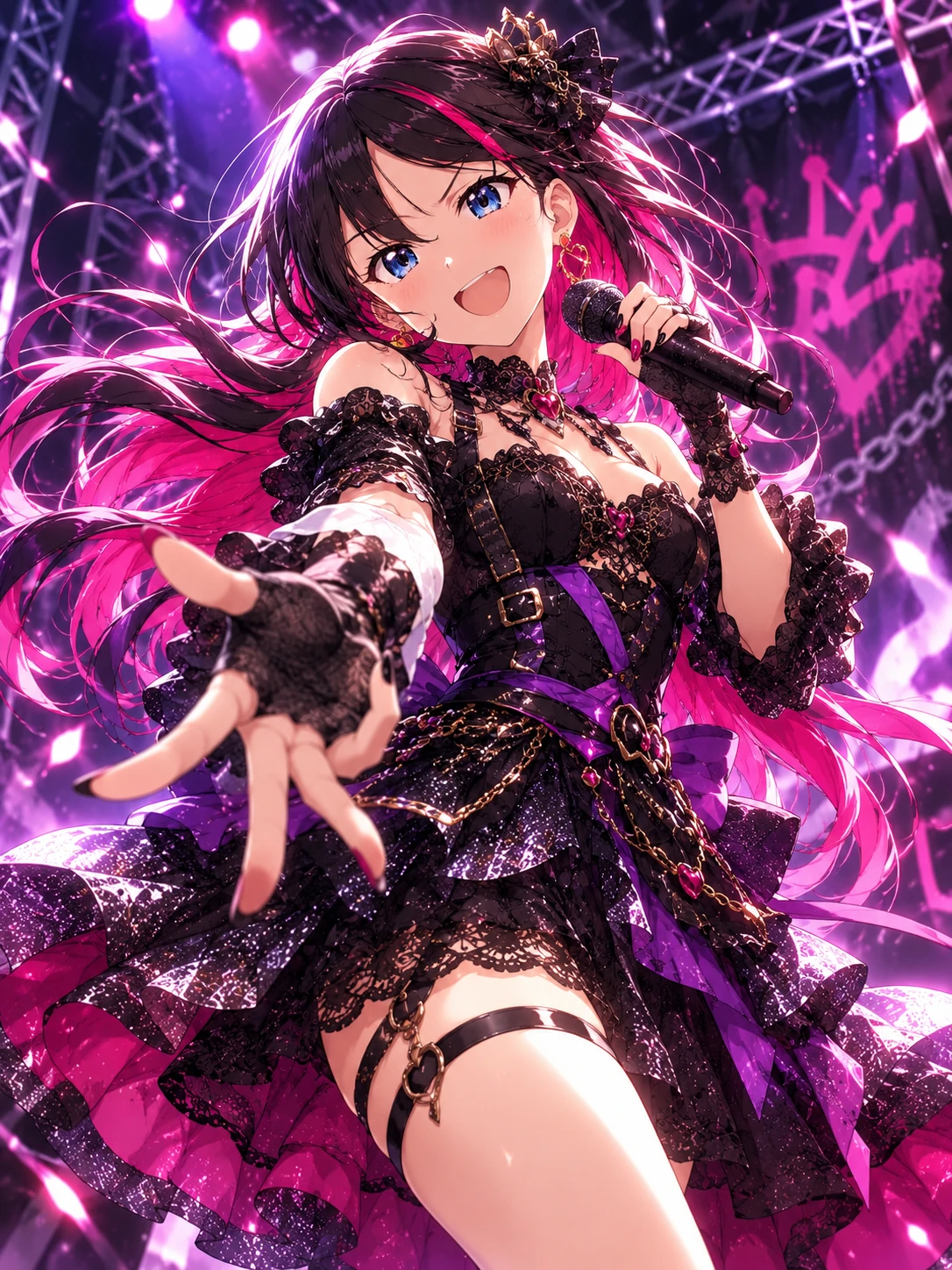
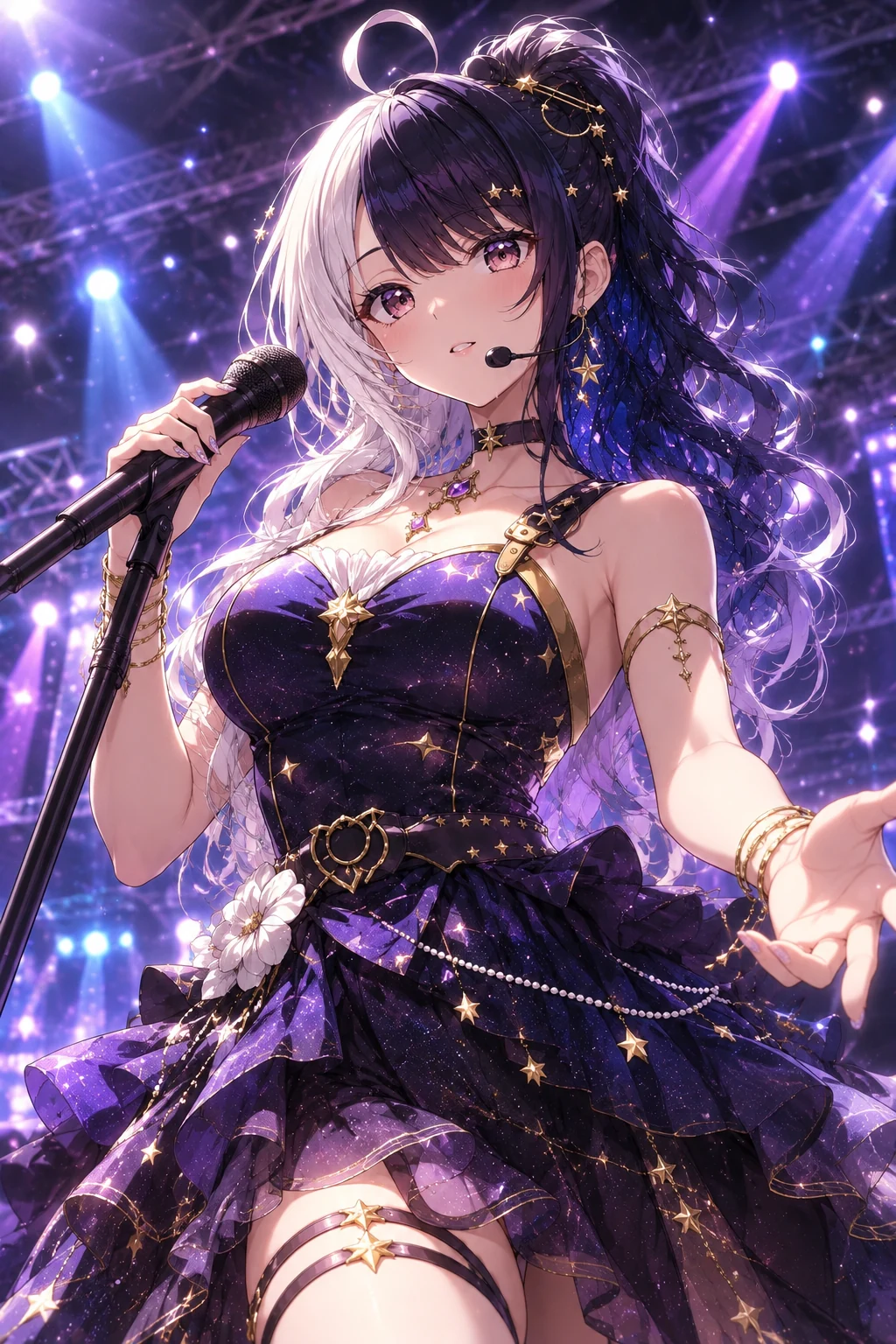
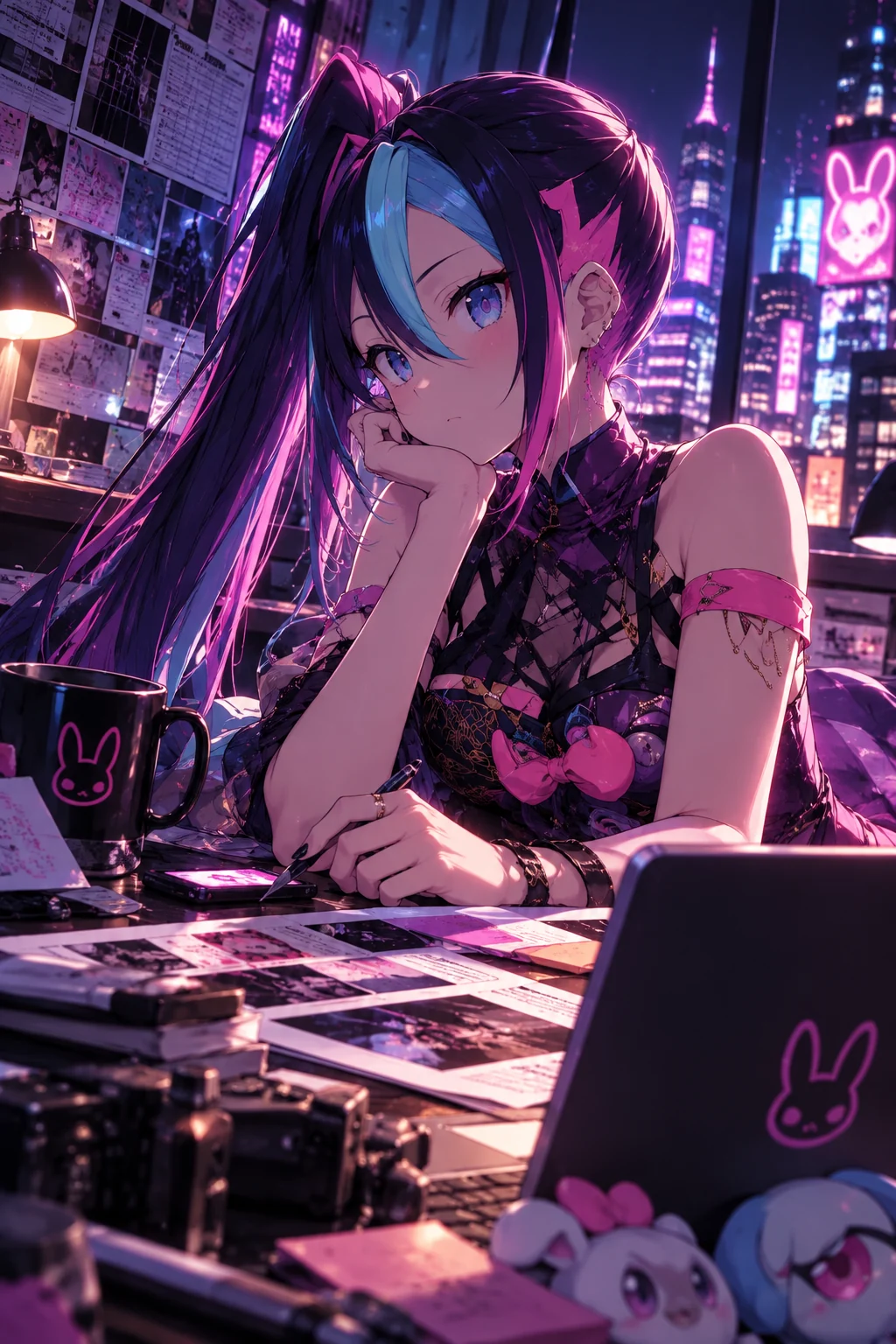
Everything the industry doesn't want you to read.
Protagonist Group
Dreamers who fight for every inch of the stage.
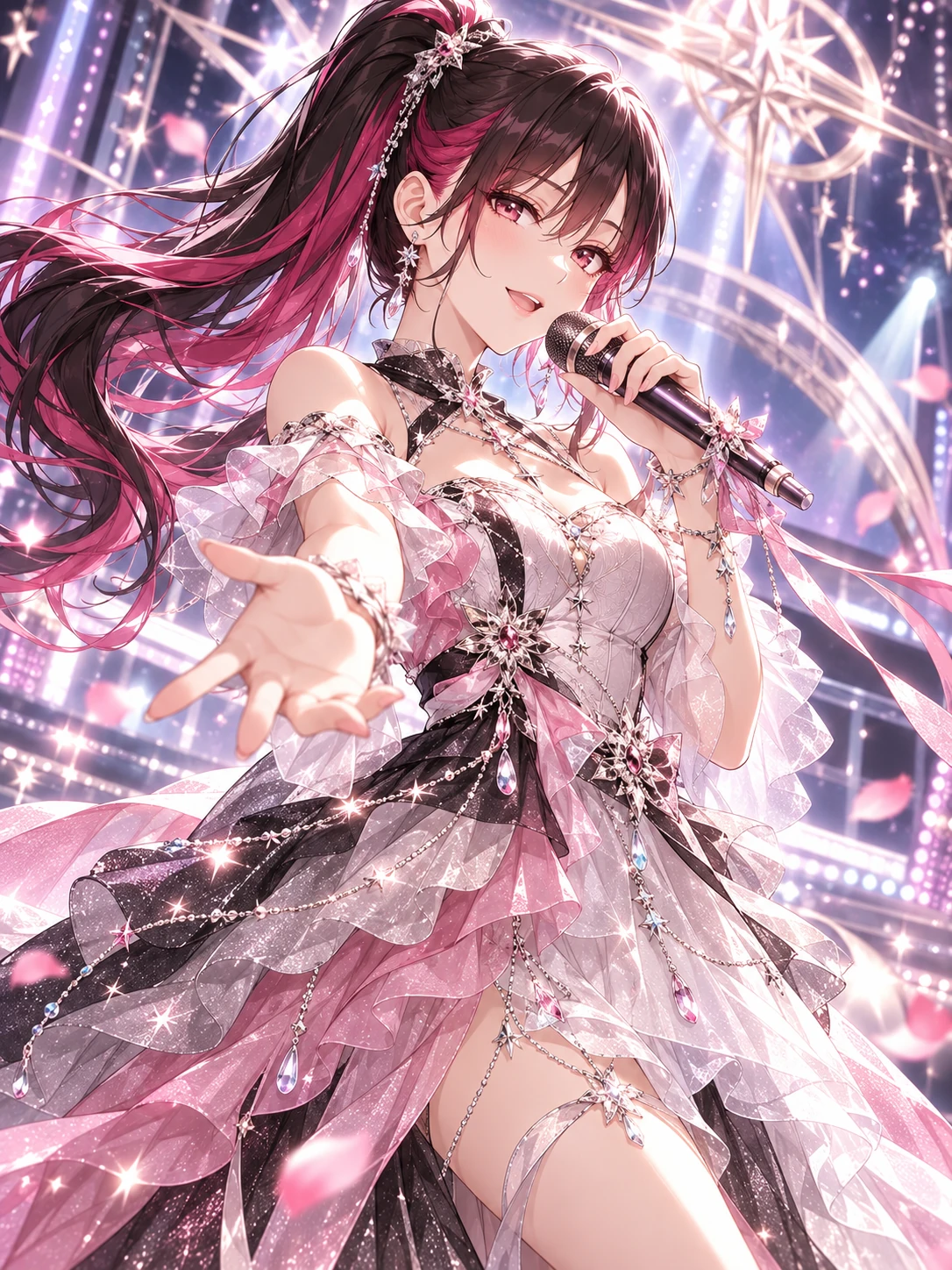
The girl who carries everyone has forgotten how to let herself be carried.
STARBREAK / Story 01 · Starlight Serenade
At 1:17 in the morning, the rehearsal studio held only two sounds: the hum of the air conditioner and Akari Minase missing the same note for the seventh time.
She stopped the track before the chorus finished. In the mirror, the leader of Starlight Serenade looked remarkably unlike the girl on the posters. Her ponytail had come loose. Her shoes were unlaced. A little square of paper was stuck to the mirror at eye level, left by Kanade Akabane after rehearsal.
Stop trying to sound perfect. Start trying to sound true.
Akari had spent an hour deciding whether that was encouragement or an insult.
Her phone lit up on the floor. No name. No photograph. Just a message: You’re still there.
I’m nearly done, she typed.
Three dots appeared, vanished, appeared again.
You said that forty minutes ago.
Akari smiled despite herself. Nyx Aoyama could disappear from camera feeds and search results, could make a trail of calls look like it had never existed. Somehow she had never learned to be subtle about worrying.
There are people who need me tomorrow, Akari wrote.
There are people who need you tonight, too.
She looked at the studio door. Nyx never used Akari’s name in a message that might be seen over someone’s shoulder. Akari had learned to delete entire conversations without reading them twice. The secrecy had once felt thrilling, like keeping a candle alive in both hands. Lately it felt like holding her breath.
The door clicked open.
Akari slid the phone facedown, but it was only Mei Tsukishiro, carrying two canned teas from the vending machine downstairs. She wore an enormous cardigan over her rehearsal clothes and had the expression of someone apologizing for existing in a hallway.
“I heard music,” Mei said. “I thought someone forgot to turn it off.”
“Sorry. Did I wake you?”
“We don’t live here, Akari.” Mei handed her a tea. “Though I think you’re trying to.”
Akari laughed, then caught herself. Mei rarely made jokes on purpose. That one had landed.
They sat against the mirrored wall. On a screen above the door, tomorrow’s rehearsal schedule scrolled past: camera blocking, costume fitting, sound check, press, live broadcast. Akari’s name appeared beside more responsibilities than anyone else’s.
“I’m supposed to lead,” Akari said. “What happens if I’m the one who can’t keep up?”
Mei turned the cold can in her hands. “I froze onstage once. You know that.”
“That was different.”
“Because it was me?”
Akari had no answer.
“You stood in front of me until I remembered the words,” Mei continued. “Afterward you told me that one bad moment wasn’t the whole song.” She looked straight at Akari, which took more courage than either of them would admit. “Does that only work for other people?”
The question sat between them. Akari thought of Natsumi making the dancers laugh when everyone’s knees hurt, of Rika Hanamura arguing with producers so the girls wouldn’t have to, of Kanade’s note on the mirror. She had been treating their love like something fragile she needed to protect from herself.
“Maybe I don’t know how to stop being the center,” Akari said.
Mei reached over and gently peeled the note from the glass. She folded it once, then put it in Akari’s hand. “Then be Akari for five minutes.”
The next evening, the lights came up on a room filled with thousands of people who knew every word. Akari stood in the center because that was where the choreography placed her. Behind her, Mei took one step closer than the marked distance. Natsumi grinned at her from the other side.
The opening verse went flawlessly. Then the chorus approached—the note Akari had spent the night trying to force out of herself.
She breathed. She heard Mei’s harmony rise under hers. Natsumi’s voice joined a beat later. For once, Akari didn’t sing as if the entire song would collapse without her.
She let the others hold it with her.
After the performance, her phone vibrated in the dark of the dressing room. The message contained no words, only a photograph of the stage taken from somewhere deep in the audience. Akari was laughing mid-song, eyes nearly closed, the other two beside her.
Below it, Nyx had written: I didn’t erase this one.
Akari stared at the picture for a long time. Then she saved it.
Continue exploring: What Helena Knows →
Rival Group
Flawless, feared, and built to last forever.
A comeback changes the schedule. A single sentence changes the room.
STARBREAK / Story 02 · Eclipse
The agency called it a scheduling adjustment.
Helena Vasilisa called it what it was: an opportunity.
On the glass wall of the conference room, a public-relations assistant had projected the following evening’s media calendar. At seven, Eclipse would announce its next campaign. At seven, on a smaller channel with a much smaller advertising budget, Seraphine Kiryuu would make her first televised comeback appearance.
The assistant cleared her throat. “They asked whether we could move our announcement.”
“Of course they did,” Helena said. “And what did you tell them?”
“That we’d consider it.”
“Then you’ve already told them too much.”
The assistant erased her expression. Helena watched her do it with professional interest. She had built an entire empire out of teaching talented people to hide their faces while keeping their smiles.
Yuna Hoshimura was waiting when the room emptied. In a white jacket prepared by the styling team, she looked like the campaign photograph standing up to demand a better contract.
“You knew about Seraphine’s broadcast before ours was scheduled,” Yuna said.
Helena turned off the wall screen. “You’ll have to be more specific.”
“You made us the answer to her comeback.”
“I made us the story.”
For a moment Yuna said nothing. That was something Helena liked about her. Anger could be trained out of a performer’s voice; thinking was harder to suppress, and sometimes far more useful.
“The press will ask whether older idols should make room for the next generation,” Helena said. “You’ll tell them Eclipse respects its predecessors. And then you’ll remind them that the future belongs to those who can sustain perfection.”
“That sounds rehearsed.”
“It is rehearsed.”
Yuna’s mouth tightened. She had sacrificed friendships, sleep, and years of ordinary life to hold the position Helena had given her. She knew exactly how quickly a younger face could be placed in the same frame.
“What if they ask about the rumors?” she said.
“Which rumors?”
“About why Seraphine disappeared.”
Helena let the silence lengthen. There were very few things she enjoyed more than letting someone discover how much of a question had been dangerous to ask.
“You will not answer questions about careers that aren’t yours,” she said at last.
That night, Aria Kisaragi passed the conference room on her way to a late vocal session. She saw Yuna still standing there, staring at the blank glass. Aria had been hiding her own songs inside folders labeled as vocal exercises. She recognized the posture of a person who had been told what she was allowed to want.
“Are you okay?” Aria asked.
Yuna looked at her reflection. “Do you ever wonder what they’d do if we stopped being perfect?”
Aria almost laughed. “Every day.”
The next evening, cameras flashed. The backdrop read ECLIPSE in letters tall enough to make the women beneath them look small. Helena watched from behind the last row of journalists while Yuna approached the microphone.
A reporter raised her hand. “With Seraphine Kiryuu returning tonight, do you think the industry should be looking forward instead of back?”
There it was. The perfect opening. Yuna knew the approved sentence. Helena could practically see it written on the air in front of her.
Yuna glanced toward the cameras. “I think anyone who still has a song to sing deserves to stand on a stage.”
The room became very still.
Then she added, “Including us.”
It was not rebellion in the way the tabloids understood rebellion. She hadn’t shouted, walked out, or named anyone. She had simply refused to make another woman’s return sound like a threat.
Helena remained expressionless while the flashes resumed.
On the monitor behind the journalists, a split-screen preview appeared. On one side stood Yuna, immaculate and young. On the other, Seraphine waited under violet lights, Astra Velour a few steps behind her.
Helena recognized Astra’s smile. It had not changed in all the years the industry had tried to forget it.
A phone buzzed in Helena’s hand. An unknown sender had attached an old promotional photograph—one that should no longer have been circulating. No accusation accompanied it. Only a question.
How many names can you keep out of the light?
Helena deleted the message. She had done that with more dangerous things before.
But for the first time that evening, she did not feel as if she controlled the room.
Continue exploring: Rika & Aria — Before the Break →
Underground Group
Raw, rebellious, and impossible to ignore.
Before the rivalry, there was a practice room and a song neither forgot.
STARBREAK / Story 03 · Neon Riot
Before Neon Riot had a name, before Eclipse taught Aria Kisaragi how to hold her chin for a camera, there was a rehearsal room with an out-of-tune piano and two girls who were always the last to leave.
Rika Kazehaya sang too loudly for the room. Aria told her so at least three times a week.
“You’re going to break a window,” Aria said one night, fingers poised over the keys.
“Then open it.”
“That is not how sound works.”
“It could be.”
Aria sighed the exhausted sigh of someone born into a family that considered music a serious profession. Then she began the introduction again, softer this time. Rika came in on the second bar and deliberately bent a note that wasn’t on the page.
Aria stopped playing.
“What?” Rika asked.
“That was wrong.”
“You smiled.”
“I did not.”
“You did. Do it again.”
They had been assigned to separate evaluations, but the song was theirs. Aria wrote the chords in tidy pencil. Rika crossed out half the lyrics and replaced them with lines about train stations at midnight, cheap coffee, and the feeling that the whole city was singing without permission. They argued about every second verse and somehow always stayed another hour.
At the bottom of the first page, Aria had written a title: Keep the Lights On.
Rika drew a lightning bolt through the underline.
One afternoon, a coordinator called them into an office that smelled of polished wood and expensive tea. Two executives sat across a table. One praised Aria’s control, her pedigree, the beautiful restraint of her voice. The other called Rika’s delivery “difficult to package.”
“You need to learn that an audience wants certainty,” he told Rika. “Not defiance.”
Rika leaned forward. “Then maybe you’ve been asking the wrong audience.”
The coordinator stared at her as if she had kicked over a glass.
Aria looked down at her hands.
That was the moment Rika remembered later. Not the exact words the executives used, and not even what happened after the meeting. She remembered Aria’s hands, folded carefully together, and how badly she had wanted her friend to say something.
Outside, they walked down the hallway without speaking. Rika kept waiting for Aria to break the silence. Aria kept searching for a sentence that might fix it without making things worse.
“Do you believe them?” Rika asked at the exit.
“About what?”
“About me.”
“No.” The answer came quickly. Too quickly, perhaps. “But you didn’t have to fight them in there.”
“Somebody did.”
Aria’s expression changed. “That’s not fair.”
Rika wanted to take it back. She also wanted Aria to understand why she couldn’t. The train arrived before either of them found the right words.
Years later, Neon Riot’s rehearsal space was no bigger than that old room, although the walls had more stickers and the amplifier was held together with tape. Noa Himuro had left a rough arrangement playing on repeat. Kuroha was arguing about the bridge. Ayane drank bottled water in the corner and pretended not to listen.
Rika found a folded page inside her notebook. She had carried it through agency interviews, rejected auditions, and every venue that had ever tried to turn down her microphone.
At the top: Keep the Lights On. Two different handwritings filled the margins.
“New song?” Noa asked, peering over her shoulder.
“Old song.”
“Good old?”
Rika thought about the train doors closing, about Aria framed in the window on the other side. There had been other conversations after that night, other things neither of them spoke about. The distance between them had not been made in a single afternoon. But that was where Rika could still hear it beginning.
“Complicated old,” she said.
Across the city, in an Eclipse practice room with spotless mirrors, Aria opened a blank score. The agency had forbidden her from releasing her own music. It had not yet found a way to stop her writing it.
She wrote four familiar chords, stared at them, and then changed the ending.
Neither woman knew what the other was doing that night. Neither was ready to call.
But in two different rooms, both left the light on.
Continue exploring: The Light We Kept →
Veteran Legends
Still burning long after the industry tried to extinguish them.
On the night the music fails, three legends remember what still belongs to them.
STARBREAK / Story 04 · Starfall
Seraphine Kiryuu had forgotten what silence sounded like from the middle of a stage.
In the rehearsal hall, it felt enormous. No audience. No cameras. Only the rows of dark seats and the sound of her own shoes crossing the boards. Tomorrow, the cameras would be back. Tomorrow, the industry would decide whether her return was a triumph, a curiosity, or a mistake.
“Again,” Astra Velour called from the front row.
Seraphine turned. “I’ve done it six times.”
“And which one was yours?”
The question stung more than criticism. Seraphine had spent years imagining what her comeback would look like. She had watched younger idols master camera work, social media, the kind of precision she once owned without trying. Now every movement felt like an imitation of the woman she used to be.
Naomi Takasago walked onstage carrying a handful of gold star pins. “Hold still. You’re trying to outshine your own costume.”
“It’s the costume they remember.”
“They remember you wearing it.” Naomi clipped a pin into Seraphine’s hair. “There’s a difference.”
A laugh came from the wings. Satsuki Renge emerged in a coat that looked more expensive than the venue. Reina Saionji followed her, composed as ever, her face giving away nothing.
“I came to watch,” Reina said.
“You came to judge,” Satsuki corrected.
“Both can be true.”
Seraphine folded her arms. The three of them had never officially abandoned Starfall. The industry had simply found ways to move them out of the spotlight one by one. It was difficult to explain how a group could survive without standing in the same room, and harder still to explain how complicated it felt when they finally did.
From the front row, Astra lifted one finger. “Positions, please. We have a show tomorrow.”
The backing track began. Seraphine took her mark. She raised her headset microphone and reached for the opening note.
The speakers cracked.
Then everything went dark.
A startled shout came from the lighting booth. Someone called for a technician. The stage manager apologized three times before anyone answered. In the blackout, Seraphine could hear rain tapping against the high windows.
She stood absolutely still.
This was what fear always showed her: the moment when the stage went away and she was no longer sure she existed without it.
“Seraphine?” Astra called.
She took a breath. Without the backing track, the first note was small and exposed. She sang it anyway.
The hall caught the sound and carried it farther than she expected. On the next phrase her voice steadied. She stopped thinking about the cameras and the headlines. She sang as she had sung before anyone had called her the Cosmic Empress.
A second voice joined from the wings, low and unmistakably amused. Satsuki. A heartbeat later came Reina’s rich harmony, measured and sure.
Nobody had asked them to sing.
The three voices did not fit perfectly. They had aged into different music and different lives. But the rough edges made it impossible to mistake them for a recording.
A work light blinked on above the empty audience. It illuminated the edge of Astra’s face. Her lips moved with the melody, though no sound came out. Naomi noticed and, for once, said nothing.
When the last note faded, nobody applauded. The quiet was too full for that.
Satsuki stepped forward. “Well. I suppose we can still do that.”
Reina tilted her head toward Seraphine. “You were rushing the second verse.”
Seraphine laughed. It broke into something dangerously close to tears.
Astra climbed onto the stage. “Tomorrow, the lights may work. The cameras may behave. The world may decide it’s ready for you.” She looked at each of them. “None of that is the reason you get to sing.”
Outside, the rain kept falling. Inside, the old group that had never disbanded stood together for one more minute, making no promises about tomorrow.
The hall was no longer silent.
Continue exploring: The Story Beneath the Story →
Whistleblowers, Hackers, Soloists
The ones who refused to be owned.
A journalist receives a missing page. A whistleblower refuses to let it become another lie.
STARBREAK / Story 05 · Independent
The envelope had no return address.
Kagerou Nanase found it underneath the door to the small office where she published Backstage Ghost. Most of her mail was ordinary: tips written in anger, messages from fans, threats composed by people who believed that saying legal action made them sound important.
This envelope contained one piece of paper.
It was a photocopy of a concert program from years ago. Between two performers’ names, the text had been covered by a clean white rectangle. Not crossed out. Not blurred. Removed so carefully that someone reading quickly would never notice there had been a name at all.
On the back, in neat block letters, someone had written: Check the first printing.
Kagerou placed the sheet beside her keyboard. Then she made coffee, opened her archives, and spent three hours learning just how many photographs could disappear from an industry that recorded everything.
Across the city, Celestia Rayne watched the message she had sent remain unread.
Once, reporters had called her the Gilded Goddess. Then a scandal had swallowed the name, and an entire career had seemed to vanish overnight. Now, behind a different identity, she collected the fragments other people wanted buried. Online, that identity was called Starbreaker.
She could have posted the altered program herself. It would have drawn attention. People loved a conspiracy, especially one that could be explained in a single image. But Celestia had learned the cost of a story outrunning its evidence. She did not want to make another woman famous for the wrong reason.
At eleven, Kagerou’s reply arrived.
This proves a document was changed. It does not prove who changed it or why.
Celestia stared at the words. She hated how much she respected them.
There was a name on the first printing, she wrote.
Then send me the first printing.
It would have been easier if Kagerou had been reckless. Reckless people could be aimed like spotlights, bright for one night and gone by morning. Careful people asked for sources. They waited. Sometimes they refused the truth when it arrived dressed as a rumor.
Celestia went to the back of her wardrobe and took down an old garment bag. Beneath a dress she had not worn since her idol days was a folder she had promised herself she would never open again.
Inside were photographs, ticket stubs, and a folded program from a concert whose organizers no longer acknowledged her presence. The first printing was there. The missing name, too.
It did not tell the whole story. It did not identify the person who had ordered the edit. But it showed that the disappearance was real.
Celestia photographed the page, including the creases and the ink bleeding through from the back. She sent it, then sat on the floor in the dark while her phone stayed silent.
An hour passed.
At last Kagerou replied: I can verify these editions. I’m working on the rest. I will not publish a name until I know what the evidence means.
I didn’t ask you to protect them, Celestia typed.
I’m trying to protect the person whose name it is.
Celestia read that sentence several times. She remembered what it was like to wake up and find strangers explaining her life to one another as if she had never lived it herself.
She closed the folder.
A new draft appeared on Backstage Ghost the following morning. It was not an accusation. It asked a question: why had two official editions of the same concert program listed different performers? Kagerou included both documents and an invitation for anyone with firsthand knowledge to contact her securely.
There were no villains named, no dramatic conclusions. By midday, people had begun sending other programs.
Celestia stood on a crowded station platform, reading the first replies. They were small things: dates, pages, a misplaced credit, a photograph cut to exclude someone at the edge. Small things added together until an absence had edges.
Her train arrived. For the first time in a long while, she let herself imagine that the truth might survive being told carefully.
Continue exploring: The Weight of the Center →